On this page
- What Does a UGC Brief Actually Ask You For?
- How Do You Sort a Brief Before Writing a Single Line?
- What If the Brief Is Vague?
- How Do You Map Each Brief Point to a Scene?
- How Long Should Each Part Be in a 15, 30 or 60 Second UGC Video?
- Worked Example: One Brief In, Script and Shot List Out
- What Claims Must You Leave Out of the Script?
- How Do You Handle Disclosure in the Script?
- How Do You Write the Script in Urdu, Roman Urdu or Hindi When the Brief Is in English?
- What Should You Send the Brand Before Filming?
- Mistakes That Turn a Good Brief Into a Reshoot
- FAQ
- Sources
Quick answer: To turn a UGC brief into a script, sort every point in the brief into must say, nice to have and must not say, then give each must-say point its own scene with a time in seconds. Put the hook and the product promise in the first 3 seconds, keep claims to what the brief allows, and send the script, shot list and hook options for approval before you film.
TikTok's own creative guide for advertisers, last updated in June 2025, asks for two things in the opening of every ad: introduce the content proposition in the first 3 seconds, and land the hook within the first 6 (TikTok creative best practices). Now open the last brief a brand sent you. It probably has a goal, six "key messages", three mandatory shots, a list of words you can't say, and a 30 second limit. Nothing in it tells you which of those six messages goes in those first 3 seconds, or what to cut when they don't fit.
That gap is the whole job. We read the pages ranking for "UGC brief to script" on 24 November 2026. Almost all of them are written for brands: how to write a brief, what to put in it, which platform to post it on. The one or two pages written for creators stop at "read the brief carefully". None of them takes a real-looking brief and turns it into a script and a shot list, line by line, with timings.
This guide does that, from the creator's side, with a worked example you can copy.
What Does a UGC Brief Actually Ask You For?
A UGC brief tells you what the video must achieve and what it must contain; the script is your plan for saying and showing all of that inside a fixed number of seconds. The brief is the brand's wish list. The script is your edit of it.
Most briefs, whatever template the brand uses, carry the same parts:
- Goal: awareness, a product launch, app installs, or sales from an ad.
- Viewer: who the video speaks to, for example "working women 22 to 35 in Lahore and Karachi".
- Key messages: the points the brand wants a viewer to remember.
- Mandatory shots: product in hand, a texture close-up, the app screen, the packaging.
- Claims and words to avoid: the legal and policy limits.
- Tone and references: "friendly, not salesy", plus two or three example videos.
- Deliverables: length, number of videos, number of hooks, raw files, deadline.
- Usage: organic only, paid ads, Spark Ads codes, and for how long.
If any of these is missing, you don't have a full brief yet. Our list of questions to ask brands before you film covers how to get the missing parts in one message.
Once you have the brief sorted, you can draft the first version fast in Breakoutly's Studio, which writes a script, hook options and cover text in English, Urdu, Roman Urdu, Hindi, Arabic and Bahasa from the points you give it. You still edit every line so it sounds like you. The method below works with or without it.
How Do You Sort a Brief Before Writing a Single Line?
Sort every line of the brief into three groups: must say, nice to have, and must not say. Do it before you think about hooks, because the hook has to come out of the must-say group.
Copy the brief into a note and mark each point:
- Must say: points the brand calls key, mandatory or required, and anything that is the reason the product exists (the one promise).
- Nice to have: secondary benefits, brand story, the discount code if it's optional, "mention our new packaging if you can".
- Must not say: banned words, medical or result claims, competitor names, prices if they may change, anything the brief lists under "avoid".
Then count. In a 30 second video you can usually land one main promise and two supporting points clearly. If the must-say group has six items, you're not writing a script yet. You're writing a question to the brand: "Which two of these matter most for this video?" That one message saves a reshoot.
Two more things to spot while sorting. First, anything about usage, such as "we may run this as a paid ad" or "please provide a Spark Ads code", changes your price, so check it against our guide to UGC usage rights before you agree. Second, the deliverables line tells you how many openings to plan. "3 hooks" means three different first lines on one body, which our guide on filming hook variations shows how to shoot without filming the video three times.
What If the Brief Is Vague?
If a brief is vague, write the script on sensible defaults and send the brand one batched message that states those defaults and asks only what you can't decide yourself. Don't send five separate messages over two days.
Sensible defaults for most UGC briefs:
- Length: 30 seconds unless they said otherwise.
- Format: vertical 9:16, which TikTok asks for, at 720p or higher (TikTok creative best practices).
- Structure: hook, problem, product in use, proof you can show, call to action.
- Language: the language of the brand's own recent posts.
- Hooks: one, unless they asked for more.
Here is a message you can adapt. The English version:
"Hi, thanks for the brief. Before I write the script I'm planning a 30 second vertical video in Roman Urdu with one hook, focused on (main promise). Can you confirm three things: which two messages matter most, whether I can mention the price, and whether this will run as a paid ad? I'll send the script and shot list for approval before filming."
And in Roman Urdu, for local brands that write to you in Urdu:
"Assalam o alaikum, brief ka shukriya. Script likhne se pehle confirm kar dein: video 30 second ki vertical hogi, Roman Urdu mein, ek hook ke saath, aur focus (main promise) par hoga. Teen cheezein bata dein: sab se zaroori do messages kaun se hain, price mention kar sakti hoon ya nahi, aur kya ye paid ad mein chalegi? Filming se pehle script aur shot list approval ke liye bhej doon gi."
How Do You Map Each Brief Point to a Scene?
Give every must-say point its own scene, with a line to say, a shot to show and a time in seconds. If a point has no scene, it won't make the video; if a scene has no point from the brief, ask why it's there.
| Brief part | Where it goes in the video | What the viewer sees | Typical time in a 30 s video |
|---|---|---|---|
| Main promise | Hook, first 3 seconds | Product or result in frame, first line on screen | 0 to 3 s |
| Problem the viewer has | Right after the hook | You, hands or the situation | 3 to 8 s |
| Key message 1 | Product in use | Close-up of the mandatory shot | 8 to 16 s |
| Key message 2 | Proof you can show | Texture, before and after of a task (not a body), app screen | 16 to 23 s |
| Brand name and offer | Just before the end | Packaging, logo side to camera | 23 to 27 s |
| Call to action | Last line | You pointing to where to buy or tap | 27 to 30 s |
| Must not say | Nowhere | Checked in the final read-through | 0 s |
Two rules keep this honest. The hook must come from the must-say group, never from a nice-to-have, because TikTok's guidance puts the proposition in the first 3 seconds. And every mandatory shot in the brief appears in the shot list with its own line number, so the brand can tick it off.
How Long Should Each Part Be in a 15, 30 or 60 Second UGC Video?
Time each part in seconds, not words, and check it by reading the script aloud with a stopwatch. Word counts change with language and speaking speed, and the two vendor guides we read on 24 November 2026 gave different word counts for the same length without citing a source.
These timings are our recommended starting point, built around TikTok's 3 second and 6 second guidance. Adjust them to the brief.
| Part | 15 s video | 30 s video | 60 s video |
|---|---|---|---|
| Hook | 0 to 2 s | 0 to 3 s | 0 to 3 s |
| Problem or setup | 2 to 4 s | 3 to 8 s | 3 to 12 s |
| Product in use | 4 to 10 s | 8 to 16 s | 12 to 30 s |
| Proof or second benefit | not enough time, merge with product in use | 16 to 23 s | 30 to 45 s |
| Brand, offer, objection | 10 to 13 s | 23 to 27 s | 45 to 55 s |
| Call to action | 13 to 15 s | 27 to 30 s | 55 to 60 s |
For a word budget, measure yourself instead of trusting a table. Our TikTok script template explains the two minute voice recorder test: talk about the product for 60 seconds the way you would on camera, count the words, and that's your budget. If you mix Urdu and English in one sentence, time the mixed version, because that's what you'll actually say.
Worked Example: One Brief In, Script and Shot List Out
Sample brief, made up for this guide (no real brand):
- Product: a lightweight SPF 50 sunscreen from a Karachi skincare brand.
- Goal: paid ad for a summer launch.
- Viewer: women 20 to 35 who skip sunscreen because it feels heavy.
- Key messages: no white cast, light texture, works under makeup, fits in a handbag, launch price, made for hot humid weather, dermatologist tested, new pump bottle.
- Mandatory shots: texture on the back of the hand, product next to a makeup bag, pump close-up.
- Avoid: "cures", "treats", "100% protection", "removes dark spots", any competitor name.
- Deliverables: one 30 second video, 3 hooks, Roman Urdu, raw files.
- Usage: paid ads for 3 months.
Sorted:
- Must say: no white cast, light texture, works under makeup.
- Nice to have: handbag size, humid weather, new pump. Launch price and "dermatologist tested" go to the brand as questions: is the price fixed for the ad's 3 months, and can they share the testing claim wording exactly as approved?
- Must not say: everything in the avoid line, plus any skin result you can't show on camera.
The script, 30 seconds, Roman Urdu with brand terms in English:
| Time | Line | Shot |
|---|---|---|
| 0 to 3 s | Hook A: "Sunscreen jo bilkul white cast nahi chhorti." | Shot 1: half the hand with product rubbed in, half without, daylight |
| 3 to 8 s | "Garmi mein heavy sunscreen lagana kisi ko pasand nahi, main bhi skip kar deti thi." | Shot 2: hands fanning, window light, no face needed |
| 8 to 16 s | "Ye itni light hai, dekhein, ek pump aur foran absorb." | Shot 3: pump close-up. Shot 4: texture on back of hand |
| 16 to 23 s | "Aur makeup ke neeche bhi aaram se baith jati hai." | Shot 5: product next to makeup bag, foundation over the sunscreen on the hand |
| 23 to 27 s | "(Brand) ki nayi SPF 50, bag mein bhi fit." | Shot 6: bottle into handbag |
| 27 to 30 s | "Link bio mein hai, summer se pehle try karein." | Shot 7: bottle to camera, end frame |
Hooks B and C, filmed on the same frame as Hook A so the editor can swap them:
- Hook B: "Aap bhi sunscreen is liye skip karti hain kyun ke wo heavy lagti hai?"
- Hook C: Shot only, no words for 2 seconds: one pump on the hand, then "No white cast" as on-screen text.
The shot list the brand gets, in filming order (film by location, not by script order):
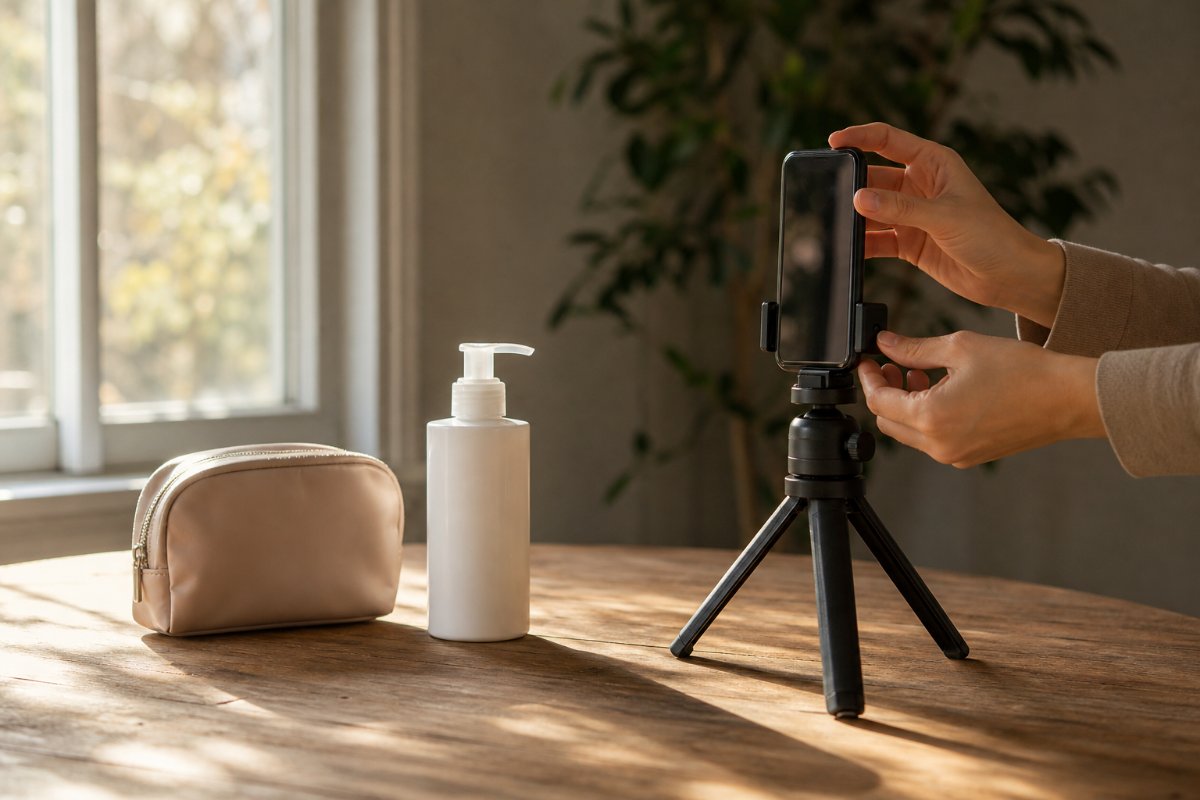
- Shot 3: pump close-up, table, window light. Mandatory.
- Shot 4: texture on back of hand, same table. Mandatory.
- Shot 1: hand comparison for Hook A, same table.
- Shot 5: makeup bag and foundation over sunscreen, same table. Mandatory.
- Shot 6: bottle into handbag.
- Shot 2: hands fanning near the window.
- Shot 7: bottle to camera, end frame, held 2 seconds.
- Hooks B and C, recorded last on the same frame as Shot 1.
Notice what's missing. "Cures", "100% protection", "removes dark spots" and the dermatologist line appear nowhere, and the launch price waits for the brand's answer. That's the script doing its job: everything in it is either asked for, allowed, or shown.
What Claims Must You Leave Out of the Script?
Leave out any claim the brief doesn't approve word for word, any result you can't show on camera, and anything TikTok bans in branded content. The brand carries legal risk for the ad, but the video carries your face or hands and your account.
TikTok's Branded Content Policy, effective 30 October 2026, says you must not make false, deceptive or misleading claims about products or services (TikTok Branded Content Policy). The same policy lists categories that can't be promoted as branded content at all, including weight loss products, some healthcare such as teeth whitening and hair growth, and CBD, plus restricted categories such as alcohol, energy drinks, financial services and supplements that carry extra rules. If a brief falls into one of those categories, check the current policy before you agree to the job, not after you've filmed.
In practice, three kinds of lines get creators in trouble:
- Medical or result words: cures, treats, heals, removes, guaranteed results, permanent.
- Absolute words: 100%, never, always, the best, number one, unless the brand gives you the proof and the exact approved wording.
- Comparisons: naming a competitor, or "better than the expensive brands".
When a brief asks for one of these, reply with a safe version: "works under makeup" instead of "best for makeup", "feels light on my skin" instead of "suits every skin type".
How Do You Handle Disclosure in the Script?
Plan the disclosure into the script itself: a spoken or on-screen label where local rules ask for one, and TikTok's content disclosure setting turned on if the video goes out on your account. Disclosure is not optional decoration at the end.
On TikTok, the policy says you must turn on the commercial content disclosure toggle for branded content (TikTok Branded Content Policy). The resulting labels read "Paid partnership" or "Commercial content", and TikTok says its own study of nearly 2 million videos, with tests that included Indonesia and Pakistan, found no performance difference for disclosed videos (TikTok content disclosure setting). That's TikTok's study of its own platform, so treat it as their finding, not an independent one. Our guide to the TikTok paid partnership label walks through the setting step by step.
Local rules add to that:
- India: the self-regulator ASCI allows only specific labels, such as #Ad, #Advertisement, #Sponsored, #Collaboration and #Partnership. For a video over 15 seconds and under 2 minutes, the label has to stay on screen for at least a third of the video; for a video of 15 seconds or less with no caption, at least 3 seconds (ASCI FAQ). In a 30 second script, that means a label on screen for at least 10 seconds, so write it into the shot list.
- UAE: a press report from July 2025 says the UAE requires an advertiser permit for promotional content on social media whether it's paid for or not, with a visitor permit valid for three months (The National). Whether that applies to UGC that only runs on a brand's own account is a question for the brand's legal team, so ask before you post anything yourself.
- Pakistan: we did not find a Pakistan-specific influencer disclosure code as of 24 November 2026. Follow TikTok's rules and the brand's instructions, and keep the disclosure even when nobody asks for it.
If the video will only run as an ad from the brand's account, the brand handles the ad label. If it also goes on your profile, you handle the toggle.
How Do You Write the Script in Urdu, Roman Urdu or Hindi When the Brief Is in English?
Write the script in the language the viewer speaks and keep the brand's own terms in English. Most Pakistani and Indian briefs arrive in English, but the viewer in the brief usually scrolls in Urdu, Roman Urdu, Hindi or a mix.
Three habits help:
- Keep product names, SPF numbers, ingredient names and the offer in English exactly as the brand writes them, so the legal team can check them.
- Write the spoken lines the way you'd say them to a friend. "Ye itni light hai" sounds like a person; a word-for-word translation of "lightweight formula" doesn't.
- Send the brand an English line under each Urdu or Roman Urdu line in the approval pack, so a reviewer who doesn't read Urdu can still approve it.
To see how creators in your language open videos in your niche, filter by language in Discover and look at videos with a high outlier multiplier, meaning views far above that creator's own median. Use them to understand the opening, never to copy the lines.
What Should You Send the Brand Before Filming?
Send one approval pack in one message: the script with timings, the shot list in filming order, the hook options, what you'll wear and which props you'll use, and any open questions. Filming before the brand approves the script is the most common cause of reshoots.
The pack, in order:
- Script table with time, line, shot, plus an English line under each Urdu or Roman Urdu line.
- Shot list in filming order, mandatory shots marked.
- Hook options, labelled A, B and C.
- Outfit, background and props, one line each.
- Disclosure plan: which label, where on screen, how long.
- Open questions, numbered, so the brand can answer "1 yes, 2 no".
- A line asking for written approval: "Please reply approved, or send changes in one message."
If you're new to this side of the work, our step-by-step guide to becoming a UGC creator in Pakistan covers portfolios, pricing and pitching around this.
Mistakes That Turn a Good Brief Into a Reshoot
- Writing the hook from a nice-to-have point. The brand wanted "no white cast" first, you opened with the packaging.
- Fitting all eight key messages into 30 seconds. Nothing lands. Ask which two matter.
- Copying claim words from the brand's website into the script. Websites and ads follow different rules.
- Filming in script order. You waste light moving between rooms; film by location.
- Forgetting the mandatory shot list. If the brand can't tick "pump close-up", the video goes back.
- Leaving disclosure for the caption. In India, the label has a minimum on-screen time.
- No written approval. "Looks good" in a voice note is easy to forget; "approved" in text isn't.
FAQ
What is the difference between a UGC brief and a UGC script?
A UGC brief is the brand's list of goals, messages, shots, claims and deliverables. A UGC script is the creator's plan that fits those points into seconds: the exact lines, the shot for each line and the timing. The brief says what; the script says how, and the brand usually approves the script before filming.
How many hooks should I write for a UGC brief?
Write the number the brief asks for, usually one or three. If it doesn't say, write one main hook and offer two more as an add-on. TikTok suggests testing 3 to 5 different creatives per ad group, which is one reason brands ask for hook variations on a single body.
How long should a UGC script be for a 30 second video?
Time it, don't count it. A 30 second video usually fits a 3 second hook, one problem, the product in use, one proof point, the brand and a call to action. Read the script aloud with a stopwatch; if it runs past 30 seconds, cut a nice-to-have point, not the hook.
What should I do if the brand's brief has no script?
Write the first draft yourself on sensible defaults: 30 seconds, vertical, one hook from the main promise, mandatory shots included, no claims beyond the brief. Send it with the shot list and numbered questions in one approval message, and film only after the brand replies "approved".
Can I change the brand's lines in the brief?
You can suggest changes, but keep any claim, product name or offer exactly as the brand approved it. Rewording a claim can make it a different claim. Rewrite only the spoken, casual lines so they sound natural in your language, and show the brand both versions in the approval pack.
Sources
- TikTok creative best practices, TikTok for Business, page updated June 2025, checked 24 November 2026.
- TikTok Branded Content Policy, effective 30 October 2026, checked 24 November 2026.
- About the content disclosure setting for creators, TikTok for Business, page updated April 2026, checked 24 November 2026.
- ASCI influencer advertising FAQ, Advertising Standards Council of India, checked 24 November 2026.
- UAE social media advertiser permit, The National, 30 July 2025, checked 24 November 2026.
By Breakoutly Research
Breakoutly researches short-form video for creators outside the US. Every article cites its sources and is checked by a person before it goes live.