On this page
- Why does hair care suit faceless UGC?
- How do the shot lists below work?
- 10 hair care UGC video ideas with shot lists
- What setup do you need at home?
- What claims must you avoid in hair care UGC?
- What should you check before you film?
- How do you research before you shoot?
- How do you turn these samples into paid work?
- FAQ
Quick answer: The best hair care UGC video ideas for beginners show what a camera can honestly see: an oil pour, a scalp oiling shot from behind, a shampoo lather test, a comb gliding through conditioned hair, a serum drop on dry ends. Film them faceless in 9:16 with three hook takes each. Never claim a product stops hair fall, regrows hair or cures dandruff.
Hair care looks like the easiest UGC category. You already own a shampoo, an oil and probably a serum somebody gifted you. Then you sit down to film and realise the only script in your head is "isse mere baal girna band ho gaye". That one sentence is exactly what gets an ad rejected.
We read the pages ranking for hair care UGC video ideas on 21 November 2026. What's there: freelancer gig and portfolio pages, AI template galleries, one vendor page selling a "before and after" hair mask transformation, and a general beauty post that tells you to show "results" without saying which results you're allowed to show. Not one timed shot list for oil, shampoo or serum. Nothing for creators who'd rather not be on camera.
So this is the version we wanted to find. Ten faceless ideas with timed shots and three hooks each (some in Roman Urdu), then the claims section, sourced to TikTok's own ad policies. No brand names on purpose. Use what's in your bathroom.
Why does hair care suit faceless UGC?
Hair care suits faceless UGC because everything a brand wants to see sits below or behind your face: the product's texture, how it spreads, the lather, the lengths of your hair, your hands doing the work. A camera behind your shoulder captures all of it.
There's a second reason, and it's about safety rather than shyness. A face next to a hair product invites the viewer to read a result into it: "her hair is thick, so the oil works." A back-of-head shot of oil going onto a parting promises nothing. It just shows a routine. That keeps you well away from the claims that cause trouble later.
One more thing in your favour if you're in Pakistan, India or Bangladesh. Oiling is a habit people grew up with. A slow champi shot doesn't need explaining to your audience, and brands selling to South Asian buyers at home or abroad know that.
How do the shot lists below work?
Every idea uses the same four rules, so you can film several in one afternoon:
- Length and format. 20 to 40 seconds, vertical 9:16, filmed at the best quality your phone has. TikTok's own creative best practices ask for 9:16 and at least 720p.
- Three hooks. Film the first 2 to 3 seconds three different ways. The same TikTok page says to put your hook in the first 6 seconds and your main point in the first 3, and brands test openings against each other.
- A clean copy. Export one version with no music, no captions and no stickers. The brand's editor adds their own.
- Timings are guides. Your real takes will run long. Cut them down in the edit.
If the hook part is new to you, TikTok hooks in Urdu has patterns that carry over to product videos.
10 hair care UGC video ideas with shot lists
1. The oil pour (any hair oil)
The most reused clip in hair care ads. An editor can drop it into almost anything as B-roll.
- 0 to 3s: hook. The closed bottle on a wooden surface, your hand turns it toward the light.
- 3 to 8s: open the cap, tilt, and let a thin stream fall into your palm. Film it close.
- 8 to 14s: rub palms together slowly so the camera sees how thin or thick the oil is.
- 14 to 22s: run both palms down the lengths of your hair, filmed from behind.
- 22 to 28s: fingers flick the ends in window light.
Hooks: "Oil ki consistency dekh lein, phir decide karein." / "Heavy oil or light oil? Watch the pour." / "This is how much I use for shoulder-length hair."
2. The parting shot (scalp oiling from behind)
This is the champi shot. Set the phone on a shelf behind you at head height, or ask a sibling to hold it.
- 0 to 3s: hook. A tail comb draws one clean parting down the back of the head.
- 3 to 10s: the nozzle or a fingertip places oil along the parting.
- 10 to 20s: fingertips massage in small circles. Slow. Let the sound of it come through.
- 20 to 28s: second parting, same thing, faster.
- 28 to 35s: hair gathered into a loose braid, bottle placed back in frame.
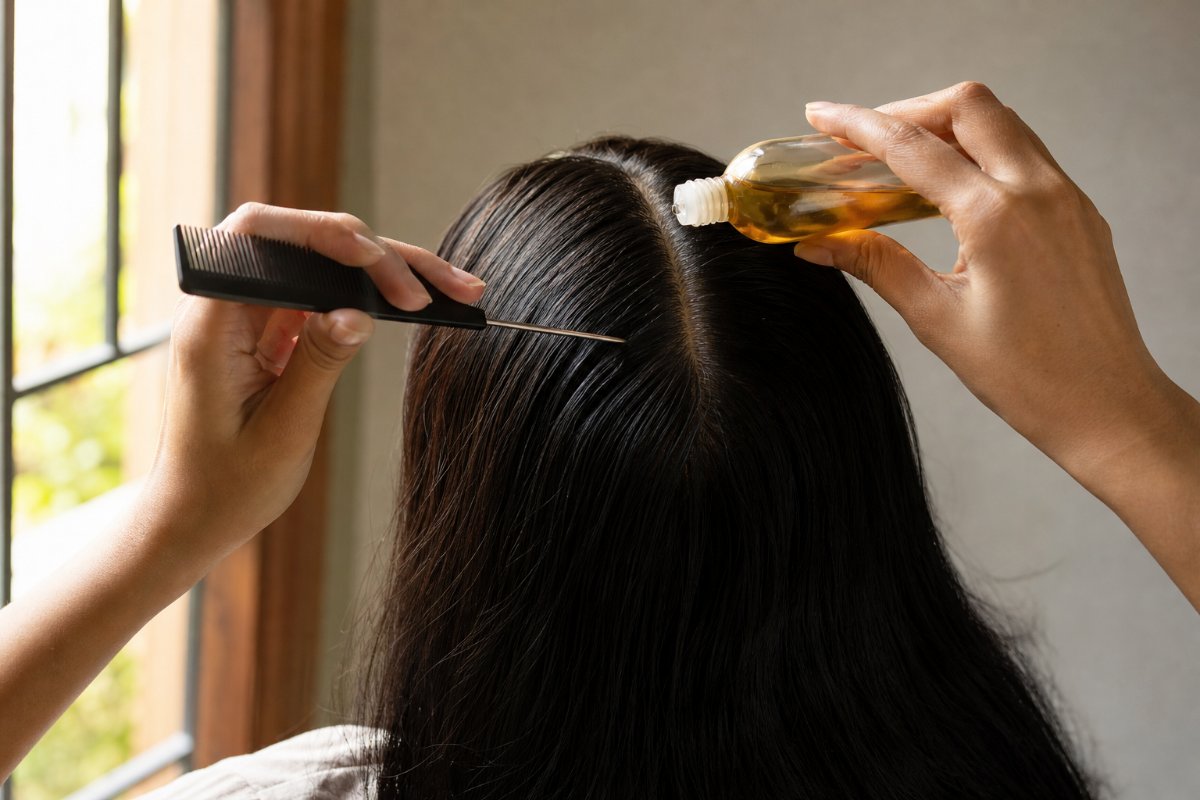
Hooks: "Sunday ki champi, step by step." / "Nozzle seedha scalp tak jaata hai, haath kharab nahi hote." / "How I oil without making a mess of my pillow."
Notice what those hooks talk about: the routine and the nozzle. Not what the oil does to your roots.
3. The lather test (shampoos)
Buyers want to know if a shampoo foams, especially the sulfate-free ones. You can show that in a bowl without washing your hair on camera.
- 0 to 3s: hook. A coin-sized amount squeezed into a wet palm.
- 3 to 10s: rub with a little water. Film the foam building.
- 10 to 18s: show the foam on your open hand, turn it in the light.
- 18 to 25s: rinse under the tap in one take, so viewers see how fast it washes off.
- 25 to 30s: bottle beside the sink, wet hands in frame.
Hooks: "Sulfate-free hai, lekin jhaag banta hai ya nahi?" / "One coin of shampoo. That's it." / "Lather test, tap water, no cuts."
4. The comb glide (conditioners and detanglers)
Slip is the thing a conditioner sells, and a wide-tooth comb shows it better than any sentence.
- 0 to 3s: hook. Wet hair filmed from behind, comb held up beside it.
- 3 to 10s: conditioner squeezed into the palm, texture shot.
- 10 to 18s: palms smooth it over mid-lengths and ends, not the roots.
- 18 to 28s: the comb goes through from the ends upward, in one continuous take.
- 28 to 32s: comb placed next to the bottle.
Hooks: "Kanghi atakti hai ya nahi, khud dekh lein." / "The comb test doesn't lie." / "Ends first, then up. Always."
Film this honestly. If the comb snags, the comb snags. A brand can't use a faked glide, and you shouldn't want your name on one.
5. The serum drop (serums and leave-ins)
- 0 to 3s: hook. Dry ends held between two fingers, close to the lens.
- 3 to 8s: one or two pumps into the palm. Count them on camera.
- 8 to 15s: palms rubbed, then pressed over the ends only.
- 15 to 22s: fingers run through; show your palm afterward so viewers see whether it's greasy.
- 22 to 28s: hair falls back into place, filmed from behind near a window.
Hooks: "Do pump kaafi hain, isse zyada mat lagana." / "Does it leave your hands sticky? Look." / "For the last two inches of your hair only."
6. The mask timer (hair masks and deep conditioners)
- 0 to 3s: hook. The open tub, a spatula or two fingers scooping.
- 3 to 12s: applied in sections to the lengths, filmed from behind.
- 12 to 18s: hair clipped up, a phone timer set for the time printed on the pack.
- 18 to 26s: cut to the rinse, water running clear.
- 26 to 34s: towel-dried hair, a hand squeezing the ends.
Hooks: "Pack par likha time hi follow karein." / "Wash day, step three." / "What a hair mask actually feels like going on."
Stop there. Don't film a "before" of dry hair and an "after" of shiny hair side by side. More on why below.
7. The wash day flatlay (multi-product ranges)
Brands with a full range (shampoo, conditioner, mask, serum) love this because it shows the order of use.
- 0 to 3s: hook. Empty towel on the bed or a tray, first product placed down.
- 3 to 15s: each product placed in order of use, one hand, one beat each.
- 15 to 25s: a finger taps each one while a voiceover or text names the step.
- 25 to 32s: a hand sweeps everything into a basket.
Hooks: "Mera wash day, order ke saath." / "Four products, four steps, nothing extra." / "If your routine has ten steps, this is the short one."
A voiceover carries this one. If you've never recorded one, how to record an Urdu voiceover on your phone covers the basics.
8. The label read (any product with an ingredient list)
- 0 to 3s: hook. The bottle turned around to the back label.
- 3 to 12s: a finger traces the first few ingredients while you read them out.
- 12 to 20s: the usage instructions, read exactly as printed.
- 20 to 26s: the size and the batch or expiry area shown clearly.
Hooks: "Bottle ke peeche kya likha hai, parh lete hain." / "I read the back label so you don't have to squint." / "First five ingredients, no opinions."
You're reading, not interpreting. Don't say what an ingredient "does" for hair unless the brand has given you that wording in writing.
9. The travel test (pumps, caps and packaging)
Nobody films this, and it's one of the first things a buyer asks in comments: does it leak?
- 0 to 3s: hook. The bottle dropped into a handbag or gym bag.
- 3 to 10s: cap closed, bottle held upside down and shaken over a white tissue.
- 10 to 18s: pump locked and unlocked, one press to show how much comes out.
- 18 to 25s: bottle weighed in the hand, placed next to a phone for size.
Hooks: "Bag mein leak hoga ya nahi? Test kar lete hain." / "Upside down for ten seconds. Let's see." / "One pump gives you this much."
10. The seven-day diary (anything you really use for a week)
- 0 to 3s: hook. A calendar or seven tally marks on paper.
- 3 to 20s: one two-second clip per day of the same step, same angle, same light.
- 20 to 30s: a hand-written note of what you noticed: smell, feel, how your hair combed.
- 30 to 35s: how much product is left in the bottle.
Hooks: "Saat din use kiya, ye mera honest experience hai." / "A week of the same oil. Notes, not promises." / "Day one to day seven, same routine."
Report feel and experience. "It smelled like coconut and my hair was easier to comb on day three" is your experience. "It reduced my hair fall" is a claim about a result, and it's not yours to make.
What setup do you need at home?
You need a window, a phone and something to hold the phone behind you. That last part is the only hard bit of hair care UGC.
- Light: stand side-on to a window between mid-morning and late afternoon. Direct sun makes oil look greasy; soft light makes it look glossy.
- Phone stand behind you: a stack of books on a shelf works. Check the frame with the front camera first, then switch to the back camera for quality.
- Background: a plain wall or a towel hung behind you. Bathroom tiles are fine if they're clean.
- Clothes: a plain dark or white top. Patterns fight with the hair.
- Sound: turn off the fan for the oiling and lather shots. Those small sounds are half the appeal.
What claims must you avoid in hair care UGC?
Avoid any claim that a hair product treats hair loss, regrows hair, cures dandruff or delivers a guaranteed result. TikTok's ad rules block these, and your sample may run as an ad.
Here's what the policies say, as of November 2026:
- TikTok's Healthcare and Pharmaceuticals ad policy (last updated September 2026) lists, under cosmetics and beauty products, that ads may not make "claims to remove or cure acne, remove wrinkles, or treat hair loss", and may not make exaggerated performance promises about a product's effect. It also says cosmetic or beauty product ads can't make medical claims without an approved medical licence or certification.
- TikTok's Misleading and false content policy (last updated November 2026) says ad content "must not promise or exaggerate results concerning a product's effect". One of its examples of what isn't allowed is showing wrinkles disappearing through a before-and-after comparison.
- TikTok Shop's seller guidance on misleading content goes further for shoppable videos and treats side-by-side hair growth comparisons without a disclaimer as a problem. We read that page through a summary tool rather than line by line, so treat it as a pointer and check the current wording for your market.
The policy page covers many markets with slightly different wording, and we didn't map every country's section. The hair loss line appeared in every cosmetics section we read.
Why does this matter for a sample no brand has paid for? Because a brand's media buyer watches your portfolio thinking, "can I run this tomorrow?" A video that says "hair fall khatam" is a video they'd have to re-edit or bin.
Say this instead
| Don't say | Why it fails | Say this instead |
|---|---|---|
| "Hair fall band ho jayega" | Claim to treat hair loss | "Ye mera weekly oiling routine hai" |
| "Naye baal aa gaye" | Regrowth claim | Leave it out. There's no safe version |
| "Dandruff ka ilaaj" | Medical claim | "Scalp wash ke baad saaf feel hua" |
| "7 din mein result" | Promised result with a deadline | "Maine 7 din use kiya, ye mera experience hai" |
| "100% natural, no side effects" | Absolute claim you can't prove | Read the ingredient list as printed |
| "Parlour jaisa keratin ghar par" | Compares to a professional treatment | "Lagane ke baad kanghi aasani se chali" |
The pattern: describe what you did and what you felt. Leave what the product causes to the brand, in wording they supply and can back up.
And if a brand's brief asks you to say hair fall will stop? Ask them, politely and in writing, whether the claim is approved for ads. Questions to ask brands as a UGC creator has the wording.
What should you check before you film?
Check the product is safe to put on your own head before you check the lighting.
- Patch test. New oil, new mask, new serum: try a little behind the ear a day before, as most packs advise.
- Read the directions. Use the amount and time printed on the pack. Don't leave a mask on overnight because it films better.
- Skip it if your scalp is irritated or broken. No sample is worth that.
- No children in hair product samples. Even for a "kids' oil", film the bottle and your own hands.
- Expiry date. If the oil has been in the cupboard since last winter, check it.
How do you research before you shoot?
Watch what's already working in hair care for your language before you pick which three ideas to film. Ten samples nobody asked for are worth less than three that look like the videos brands are already boosting.
In Breakoutly's Discover, search a term like "hair oil" or "wash day" and filter by your language. Each result shows an outlier multiplier, meaning the video's views divided by that creator's median, with the formula and how fresh the number is. A 6x video from a small account tells you more than a big creator's average day. Open "Why it worked" on two or three to see the hook and format, then keep the best in Saved as your reference folder.
When you're ready to write, Studio drafts scripts and hooks in Urdu, Roman Urdu, Hindi, Arabic, Bahasa or English, which helps when you need three hook lines and your brain offers one. And if a few creators keep showing up in your searches, add them in Tracking so you see what they post next.
Read every generated line against the table above before you film it. A tool can write "stops hair fall" as easily as you can.
How do you turn these samples into paid work?
Pick three of the ten, film them this week, and put them in a simple portfolio. Three good samples in one niche beat ten scattered ones.
Our guide to building a UGC portfolio as a beginner covers the layout, and how to pitch brands for UGC in Pakistan has the message templates. If hair care goes well, the same faceless approach carries straight over to skincare UGC video ideas, and brands that sell one often sell the other.
One rule once a brand says yes: if you post the video on your own account in exchange for payment or free product, TikTok requires you to turn on the content disclosure setting. The post gets a "Paid partnership" label. TikTok says turning it on won't affect how the post is distributed.
FAQ
What are good hair care UGC video ideas for beginners?
Good hair care UGC video ideas for beginners are short faceless demos of things a camera can see: an oil pour, scalp oiling filmed from behind, a shampoo lather test in the palm, a comb gliding through conditioned hair and a serum pressed onto dry ends. Each runs 20 to 40 seconds in 9:16 with three different hook takes.
Can I make hair care UGC without showing my face?
Yes. Hair care is one of the easiest categories to film faceless because the product, your hands and the back of your head are the whole story. Put the phone on a shelf behind you at head height, stand side-on to a window, and film the parting, the lengths and the ends.
Can I say a hair oil stops hair fall in a UGC video?
No. TikTok's ad policy for cosmetics and beauty products, last updated September 2026, does not allow claims to treat hair loss or exaggerated promises about a product's effect. Describe your routine and how the product felt instead, for example that your hair was easier to comb after oiling.
Can I show before and after results for a hair product?
It's safer not to. TikTok's misleading content policy, last updated November 2026, bars ads that promise or exaggerate results and lists a before-and-after comparison as an example of what isn't allowed. Show the application and the texture, and leave results out of a sample.
How long should a hair care UGC video be?
Aim for 20 to 40 seconds for a sample. That's enough for a hook, three or four clear shots and a closing frame with the product. Film the first 2 to 3 seconds three different ways, because TikTok's creative guidance puts the hook in the opening seconds and brands test openings.
Do I need expensive products to make hair care UGC samples?
No. Use the oil, shampoo or serum already in your bathroom. A brand judging your sample looks at lighting, steady framing, clear shots and whether your wording is safe to run as an ad. They aren't checking the price of the bottle.
By Breakoutly Research
Breakoutly researches short-form video for creators outside the US. Every article cites its sources and is checked by a person before it goes live.