On this page
- What makes clothing UGC different from other product videos?
- How do the shot lists below work?
- 12 clothing UGC video ideas with shot lists
- How do you show true fabric colour on a phone?
- What can't you say in a clothing UGC video?
- When should you film lawn and Eid content for 2027?
- How do you research before you shoot?
- How do you turn these samples into paid work?
- FAQ
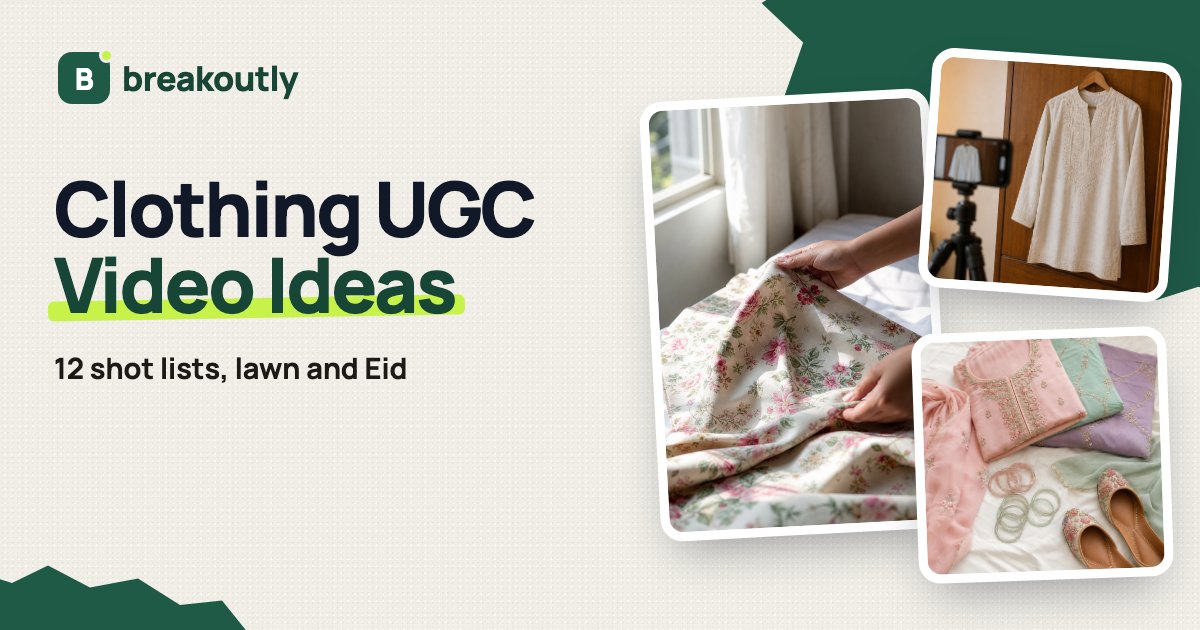
Quick answer: The best clothing UGC video ideas show what a camera can honestly prove: fabric unfolding, a dupatta draping, embroidery up close, a neck-down mirror try-on, one suit styled three ways. Film each in 9:16 for 20 to 40 seconds with three hook takes. For Pakistani lawn and Eid outfits, skip discount, "sold out" and "original" claims unless the brand's own page backs them.
Clothing should be the easiest thing to film. You own clothes. Your cupboard is the product shelf. Then you prop the phone against a mug, hold up a lawn shirt, and the print that looked mint green in your hand turns grey on screen. The dupatta slides off the hanger. You say "bohat acha fabric hai" and stop, because what else is there to say?
We read the pages ranking for clothing UGC video ideas on 23 November 2026. Most of them are AI video tool pages, freelancer gig listings and prompt galleries. The few real articles list idea names ("try-on haul", "fit check") and stop there. None of them mentions an unstitched suit, a dupatta or a tailor. None explains how to film clothes without showing your face, and several build their hooks around "selling out fast", which is exactly the kind of line that gets a brand's ad into trouble.
So here are twelve ideas with timed shots and hooks (some in Roman Urdu), written for the clothes Pakistani brands actually sell: unstitched 3-piece suits, stitched pret, dupattas and Eid outfits. After that: colour, claims, replicas and the 2027 calendar.
What makes clothing UGC different from other product videos?
Clothing UGC is different because the buyer can't touch the fabric, so your video has to answer the three questions a shop visit would: what does it feel like, how does it fall, and is the colour real. A skincare video shows texture on a hand. A clothing video has to show weight, drape and print.
UGC here means user generated content: short videos a creator films for a brand to use in its ads or on its page, usually without posting them on the creator's own account.
Lawn makes this harder and more interesting. Dawn's fashion desk quotes designer Rizwan Beyg describing lawn as a light, nearly transparent fabric and a summer essential (Dawn Images, April 2026). Light and nearly transparent is hard to judge from a product photo. A five second clip of the fabric held against a window answers it better than any caption.
And a standard unstitched suit is three pieces of fabric: shirt, trouser, dupatta. That gives you three things to film before anyone has even called a tailor.
How do the shot lists below work?
Every idea follows the same four rules, so you can batch several in one afternoon.
- Length and format. 20 to 40 seconds, vertical 9:16, at the best quality your phone records. TikTok's creative best practices for performance ads ask for 9:16 and at least 720p. That page is written for ads, which is where most brand UGC ends up.
- Three hooks. Film the opening 2 to 3 seconds three ways. The same page says to put your hook in the first 6 seconds and your main point in the first 3. Our guide on filming three hook variations for one UGC ad shows how to do it without reshooting the whole video.
- A clean copy. Export one version with no music, no captions, no stickers. The brand's editor adds their own.
- Faceless by default. Every idea works neck-down, hands-only or from behind. Add your face only if you want to.
Timings are guides. Your takes will run long; trim them in the edit.
| # | Idea | Face needed | Pieces shown | Length |
|---|---|---|---|---|
| 1 | Fabric unfold | No | Unstitched shirt | 20 to 25s |
| 2 | Three-piece flat lay | No | Shirt, trouser, dupatta | 25 to 30s |
| 3 | Embroidery close-up | No | Neckline, border, sleeves | 20 to 30s |
| 4 | Window test | No | Shirt fabric | 15 to 20s |
| 5 | Dupatta drape | No | Dupatta | 20 to 30s |
| 6 | Neck-down mirror try-on | No | Stitched suit | 25 to 35s |
| 7 | Movement test | No | Stitched suit | 20 to 30s |
| 8 | Unstitched to stitched | No | Full suit | 30 to 40s |
| 9 | One suit, three ways | Optional | Stitched suit plus extras | 30 to 40s |
| 10 | Getting ready tray | No | Outfit plus accessories | 25 to 35s |
| 11 | Chaand raat prep | No | Eid outfit | 25 to 35s |
| 12 | Parcel to hanger | No | Packaging and suit | 25 to 35s |
12 clothing UGC video ideas with shot lists
1. The fabric unfold (unstitched suits)
The simplest shot in the category, and the one editors reuse most.
- 0 to 3s: hook. The folded shirt piece on a bed or table, your hand resting on it.
- 3 to 10s: lift one corner and unfold slowly toward the camera so the print opens up.
- 10 to 18s: pinch the fabric and let it fall from your fingers. Do it twice. This is the drape shot.
- 18 to 25s: lay it flat, smooth it once with your palm.
Hooks: "Print screen pe aur haath mein, dono dekh lein." / "Unstitched lawn, straight out of the bag." / "This is how it falls. No filter."
2. The three-piece flat lay
Overhead, phone held flat above a bed sheet or a clean floor. One piece enters at a time.
- 0 to 3s: hook. Empty plain background, your hand drops the shirt piece into frame.
- 3 to 10s: arrange the shirt so the front print faces up.
- 10 to 17s: place the trouser piece beside it, slightly overlapped.
- 17 to 25s: lay the dupatta diagonally across both.
- 25 to 30s: hands leave the frame. Hold for two seconds.
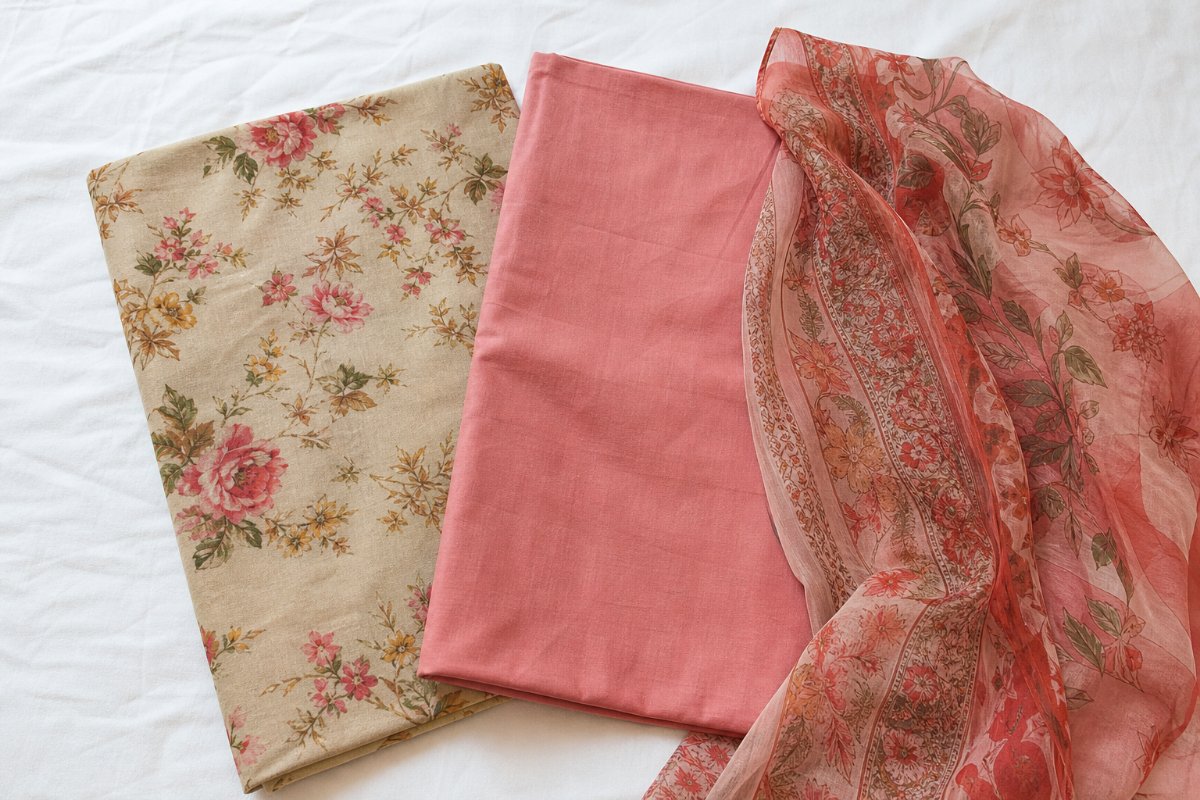
Hooks: "3 piece mein kya kya milta hai? Yeh dekhein." / "Shirt, trouser, dupatta. All three, one frame." / "Everything in the bag, laid out."
3. The embroidery close-up
Brands pay for embroidery and want it seen. Get as close as your phone will focus, then back off an inch.
- 0 to 3s: hook. A fingertip traces along the neckline.
- 3 to 12s: slow pan across the neckline embroidery, light coming from the side so the thread stands up.
- 12 to 20s: the border or daman, same slow pan.
- 20 to 28s: flip a corner to show the back of the embroidery. People check this in shops; almost nobody films it.
Hooks: "Embroidery ka ulta side bhi dekh lein." / "Close enough to count the threads." / "Neckline, border, sleeves. In that order."
4. The window test
Lawn is thin. Buyers want to know how thin, and whether it needs a lining. Don't answer with words. Show it.
- 0 to 3s: hook. Hold a single layer of the shirt fabric up against a bright window.
- 3 to 10s: put your other hand behind the fabric. The viewer sees how much shows through.
- 10 to 16s: fold it to a double layer and repeat.
- 16 to 20s: bring the fabric down and scrunch it in your fist, then release.
Hooks: "Lining lagegi ya nahi? Khud dekh lein." / "One layer against the light." / "The window test every lawn suit should pass in a video."
You're showing, not promising. If the hand shows through, that's useful to the buyer too.
5. The dupatta drape
Chiffon, lawn and organza dupattas all move differently, and that movement is the whole selling point.
- 0 to 3s: hook. The dupatta thrown gently upward and caught on camera as it floats down.
- 3 to 12s: drape it over a hanger or a chair back, let a fan move it.
- 12 to 22s: on the shoulder, filmed from behind or from the neck down. Adjust it once.
- 22 to 30s: close-up of the dupatta border or the four-sided lace.
Hooks: "Dupatta ka fall dekhein." / "Printed chiffon, in actual wind." / "The dupatta gets its own video."
6. The neck-down mirror try-on
The standard try-on, made faceless. Stand in front of a full-length mirror, hold the phone at chest height so it covers your face in the reflection, or frame from the collarbone down.
- 0 to 3s: hook. The suit on a hanger held in front of you in the mirror.
- 3 to 6s: quick cut to you wearing it. A hand snap or a hanger swipe hides the cut.
- 6 to 16s: a slow quarter turn left, then right.
- 16 to 25s: step closer to the mirror for the neckline, step back for the full length.
- 25 to 32s: one hand smooths the shirt front. Hold.
Hooks: "Hanger se pehen ke, 5 second mein." / "Stitched pret, medium, here's the length on me." / "Mirror check before I leave the house."
Say your height and the size you're wearing in the caption or voiceover if the brand asks. That's a fact about you, not a claim about the product.
7. The movement test
Every ranking page says to move in the garment, and they're right. A static pose hides how a shirt pulls at the shoulders.
- 0 to 3s: hook. Walking toward the camera, framed neck to knee.
- 3 to 10s: raise both arms as if reaching a shelf.
- 10 to 18s: sit down on a chair, then stand.
- 18 to 26s: walk away from the camera so the back shows.
Hooks: "Baith ke, uth ke, chal ke dekha." / "Does it move with you? Watch." / "Arms up, sit, walk. The honest fit test."
8. Unstitched to stitched
This one needs planning, because it spans the days your tailor takes. Film the first half before you hand the fabric over.
- 0 to 3s: hook. The unstitched pieces folded in the brand's bag.
- 3 to 10s: the three pieces laid out (reuse your flat lay shot).
- 10 to 14s: a text-free transition: your hand covers the lens.
- 14 to 25s: hand moves away, the stitched suit hangs on a door.
- 25 to 38s: neck-down try-on, one turn.
Hooks: "Darzi se pehle aur darzi ke baad." / "Three pieces of fabric, one finished suit." / "What I asked the tailor for."
Mention the design choice you made (sleeve length, trouser style). It makes the video yours, and other buyers borrow the idea.
9. One suit, three ways
Styling content gets saved, and it works with one outfit.
- 0 to 3s: hook. The suit laid flat with three sets of extras around it.
- 3 to 13s: look one: with the matching dupatta and khussa.
- 13 to 23s: look two: shirt with plain white trousers.
- 23 to 33s: look three: shirt with jeans, dupatta as a scarf.
- 33 to 38s: all three accessories back on the flat lay.
Hooks: "Aik suit, teen tareeqay." / "Office, dawat, university. Same shirt." / "Three ways to wear one lawn shirt."
10. The getting ready tray
No body in the frame at all. Good if you film in a shared house and want privacy.
- 0 to 3s: hook. The outfit folded on a bed, a tray beside it.
- 3 to 12s: hands add bangles, earrings and a watch to the tray one by one.
- 12 to 20s: khussa or sandals placed below the outfit.
- 20 to 30s: slow overhead pan across everything.
Hooks: "Kal ki dawat ki tayyari." / "Outfit planning, the night before." / "Everything I'm wearing tomorrow."
11. Chaand raat prep (Eid outfits)
The night before Eid has its own visual language: the iron, the hanger on the cupboard door, the bangles, the mehndi drying.
- 0 to 3s: hook. An iron gliding over the Eid shirt's sleeve.
- 3 to 12s: the pressed suit goes on a hanger and onto the cupboard door.
- 12 to 22s: bangles matched against the dupatta, two colours tried.
- 22 to 32s: a hand with fresh mehndi (dry, not touching the fabric) beside the outfit.
Hooks: "Chaand raat, kapray ready." / "Eid outfit, pressed and waiting." / "The last job before Eid morning."
12. Parcel to hanger
An unboxing built for clothes. Our faceless unboxing UGC shot lists go deeper on packaging shots.
- 0 to 3s: hook. The sealed parcel lands on the bed.
- 3 to 12s: open it, lift out the brand's bag or box.
- 12 to 22s: unfold the top piece toward the camera.
- 22 to 32s: the suit goes on a hanger. Hold.
Hooks: "Parcel aa gaya, khol ke dekhte hain." / "Online order, opened on camera." / "From courier bag to hanger."
How do you show true fabric colour on a phone?
Film next to a window in daylight, turn off the room's tube light, and compare the screen to the fabric in your hand before you record. Colour is the top reason clothing videos mislead by accident, and it's fixable in a minute.
Adobe's photography guide explains why it happens: different light sources have different colour temperatures, and fluorescent light can give images a green tint. So a peach shirt under a tube light drifts toward yellow-green on camera. Nikon's own TikTok setup guide tells shooters to set white balance manually to match the room instead of trusting auto.
On a phone, the practical version is this. Use one light source, the window. Put something plain white in the first frame (a sheet of paper works) and check it looks white on screen. Lock exposure by pressing and holding on the fabric. Then don't touch any filter, including the "beauty" one your camera app turns on by default.
Fine prints cause a second problem: moire, the shimmering wavy pattern a camera produces on tight checks and stripes. Adobe calls checked or striped clothing "a predictable aliasing suspect". American Cinematographer's advice is to change how big the pattern sits in the frame, by moving the camera slightly closer or slightly farther away, because moire is very hard to remove afterward. Camera guides also suggest a smaller aperture, but most phones have a fixed one, so distance and angle are your real tools. That last part is our own practical read, not something those pages say about phones.
If the colour still looks off after all that, tell the brand before you deliver. Don't grade it until it "looks nice".
What can't you say in a clothing UGC video?
You can't promise results, quote a discount that doesn't match the brand's page, use absolute terms, or call a product original when it's a copy. Those four cover nearly every clothing ad rejection you're likely to cause.
TikTok's ad policy on misleading and false content (last updated November 2026) says ads "must not promise or exaggerate results concerning a product's effect", and it flags mismatched information on price, promotion and discounts between the ad and the landing page. Its own example is an ad promising a bigger discount than the website shows. It also disallows absolute terms about a product. We didn't find a TikTok rule that names scarcity lines like "only 3 left" specifically, but a stock claim you can't check is a claim you shouldn't voice.
| Instead of | Say |
|---|---|
| "50% off, today only" | Nothing about price, unless the brand gives you the exact line |
| "Best lawn in Pakistan" | "This is the print I picked from the new collection" |
| "Pure lawn, 100% cotton" | "The fabric felt light and soft to me" (or the brand's stated composition) |
| "Colour never fades" | "This is the colour in daylight, straight from the bag" |
| "Selling out fast" | Nothing about stock |
| "Same as the designer one" | Don't film it. See below |
What about replicas of designer lawn?
Refuse them. TikTok's intellectual property ad policy (last updated April 2026) doesn't allow ads that display or promote counterfeit products, and it names "replicas, imitations, or similar unauthorized items". TikTok's Branded Content Policy (effective 30 October 2026) separately bars creator posts that promote counterfeits or unauthorised replicas of a real product.
Neither page uses the phrase "master replica". They don't need to. If a seller asks you to film a suit described as a copy of a named designer's print, the word replica is already in the policy, and your face or hands are in the evidence. Advertiser accounts can be suspended for it. Say no and move on to a brand that sells its own designs.
Two more checks before you film
Music. TikTok says businesses can't use the general music library for commercial usage and should use its Commercial Music Library. The library's terms say commercial uses outside TikTok aren't permitted, so a track cleared there isn't automatically cleared for Instagram Reels. Easiest fix: deliver without music.
Revealing shots. TikTok's adult content ad policy (last updated August 2026) lists stripping or undressing and emphasis on sensitive body parts as not allowed. That's why the try-on above cuts from hanger to wearing, with no changing on camera. We found no TikTok rule requiring modest dress for ordinary clothing ads in Pakistan, the UAE or Saudi Arabia, but local law and the brand's own audience still apply.
For the questions to settle with a brand first (usage, revisions, who pays the courier), see questions to ask brands as a UGC creator.
When should you film lawn and Eid content for 2027?
Start filming samples in December and January, so you're pitching before Ramadan begins. Brands plan Eid campaigns weeks ahead, and a creator who turns up with relevant samples in January is easier to hire than one who messages on chaand raat.
Expected dates, as of November 2026, from UAE astronomical forecasts reported by Khaleej Times:
| Event | Expected date (UAE forecast) |
|---|---|
| Ramadan begins | 8 February 2027 |
| Eid ul Fitr | 9 or 10 March 2027 |
| Eid ul Adha | 16 or 17 May 2027 |
All of these depend on moon sighting. Pakistan decides through its own Ruet-e-Hilal Committee and can land a day later than the Gulf, so treat every date as "around".
On lawn launches: we couldn't find a current, reputable source that fixes a launch month. The Express Tribune's 2013 lawn round-up lists major brands launching in the first week of March that year, and Dawn's 2026 feature notes that Eid and lawn season can land together. With Eid ul Fitr expected in early March 2027, that overlap looks likely. Check each brand's own page for dates instead of trusting a general rule, including ours.
The month by month view is in our TikTok content calendar for Pakistan in 2027.
How do you research before you shoot?
Watch what's already working for clothing in your language before you choose which three ideas to film first. Twelve samples nobody asked for are worth less than three that look like what brands are boosting right now.
In Breakoutly's Discover, search something like "lawn collection" or "eid outfit" and filter by language. Each result carries an outlier multiplier (the video's views divided by that creator's median), with the formula and the freshness of the number shown. A 7x video from a small boutique account tells you more than a celebrity's ordinary Tuesday. Open "Why it worked" on a few to see the hook and the format, and keep the strongest in Saved as a reference folder.
Studio drafts scripts and hook lines in Urdu, Roman Urdu, Hindi, Arabic, Bahasa or English when you need three openings and can only think of one. If a handful of boutiques keep appearing in your searches, add them in Tracking to see what they post as Eid gets closer.
Read every generated line against the table above before you film. A tool will write "50% off" as happily as a person will.
How do you turn these samples into paid work?
Pick three ideas, one from each group: a fabric shot (1 to 5), a try-on (6 to 8) and a styling or Eid piece (9 to 12). Film them this week with a suit you already own. That's a clothing portfolio.
UGC portfolio for beginners covers how to lay it out, and how to pitch brands for UGC in Pakistan has message templates. Small online boutiques are a realistic first target: they launch new prints often and rarely have anyone filming them properly.
One rule once a brand agrees and you post on your own account: TikTok requires you to turn on the commercial content disclosure setting for posts promoting a brand, product or service. TikTok says turning it on won't affect how the post is recommended, while leaving it off can make the post ineligible for the For You feed.
FAQ
What are good clothing UGC video ideas for beginners?
Good clothing UGC video ideas for beginners are short demos of what a buyer would check in a shop: the fabric unfolding, the three pieces of an unstitched suit laid flat, embroidery up close, a dupatta draping, and a neck-down mirror try-on. Film each for 20 to 40 seconds in vertical 9:16 with three different opening hooks.
Can I film clothing UGC without showing my face?
Yes. Clothing works well faceless because the garment is the subject. Frame from the collarbone down, hold the phone over your face in a mirror, film from behind while walking, or keep to hands-only shots like flat lays and fabric close-ups. All twelve ideas in this article can be filmed without a face.
How do I show the real colour of fabric in a video?
Film beside a window in daylight with the room's tube light switched off, and turn off every filter. Adobe notes that fluorescent light can tint images green, which is why lawn prints look dull indoors. Put a white sheet of paper in frame first to check that white looks white on your screen.
Can I mention a sale or discount in a clothing UGC video?
Only if the brand gives you the exact wording and it matches their website. TikTok's misleading content ad policy, last updated November 2026, flags ads whose price, promotion or discount doesn't match the landing page. For portfolio samples, leave prices and offers out completely.
Can I make UGC for replica designer suits?
No. TikTok's intellectual property ad policy, last updated April 2026, doesn't allow ads that promote counterfeit products and names replicas and imitations. Its Branded Content Policy bars creator posts promoting unauthorised replicas too. Turn the job down and work with brands that sell their own designs.
When should I start making Eid clothing content for 2027?
Start in December 2026 or January 2027. Ramadan is expected to begin around 8 February 2027 and Eid ul Fitr around 9 or 10 March 2027, based on UAE astronomical forecasts and subject to moon sighting. Pakistan's dates can fall a day later. Brands plan campaigns weeks before, so pitch with samples early.
By Breakoutly Research
Breakoutly researches short-form video for creators outside the US. Every article cites its sources and is checked by a person before it goes live.