On this page
- What is a hook variation in a UGC ad?
- Why do brands ask for three hooks?
- Which three hooks should you film?
- How do you film three hook variations? The 7-step order
- What has to stay identical between takes?
- A worked example: one product, three hooks
- Roman Urdu hook lines you can adapt
- How do you deliver hook variations to a brand?
- What should you agree in writing first?
- What mistakes ruin hook variations?
- How do you find hook ideas worth filming?
- FAQ
Quick answer: To deliver UGC hook variations, film the body of the ad once, then film three different openings of 2 to 4 seconds each: one problem hook, one visual hook and one question hook. Keep your clothes, light and product position identical, end every hook on the same frame the body starts from, and send the brand three finished videos plus the clean files.
"Please include 3 hooks." If you've read even two UGC briefs, you've seen that line. And if you're new, you probably did what most beginners do: filmed the whole video three times, changing the first sentence. Three hours, three slightly different videos, and a brand editor who can't cut any of them together because your sleeve is rolled up in one and down in the next.
There's a faster way, and it's the way brands actually want the footage.
We read the pages ranking for UGC hook variations on 21 November 2026. Most are AI video tools explaining how their software generates openings, a freelancer's portfolio page, and lists of 100-plus hook lines. Useful if you want lines. Useless if your question is "what do I physically film first, and what do I send?" None covers take order, continuity, or how to name the files. That's this article.
What is a hook variation in a UGC ad?
A hook variation is an alternative opening for the same ad: a different first 2 to 4 seconds attached to an identical body. The body (the demo, the benefits, the call to action) doesn't change. Only the opening does.
A hook has three layers, and a real variation changes at least one of them clearly:
- The picture. What's on screen in the first frame: the product, a problem, your hands, a mess.
- The spoken line. What you say, or what the voiceover says.
- The on-screen text. The caption that sits over the first seconds.
Saying the same sentence with a bigger smile is not a variation. Neither is swapping "Honestly" for "Okay so".
Why do brands ask for three hooks?
Brands ask for three hooks because they test openings against each other while everything else stays the same, and the opening is the part of the ad viewers judge first.
This isn't folklore. It's how TikTok tells advertisers to work:
- TikTok's ad testing guide says to "test one variable at a time", because changing several things at once makes it unclear what drove the difference. In the same guide, under creative tips, it says to vary your hooks and that "the first three seconds matter".
- TikTok's creative best practices page (last updated June 2025, still the live help page in November 2026) suggests 3 to 5 different creatives per ad group, and says to prioritise the hook in the first 6 seconds and introduce the main point in the first 3.
- TikTok's split testing help (last updated January 2026) describes testing two versions of an ad and tells advertisers to "keep the other variables the same".
Put those together and you can see the media buyer's problem. They need several creatives. They want to change one thing per test. The cheapest thing to change is the opening. So: one body, three hooks, three ads.
That tells you your job. You're not making three videos. You're making one video with three interchangeable front doors.
We haven't quoted any "hooks lift performance by X%" numbers here. The pages that state them don't link a source, so we left them out.
Which three hooks should you film?
Film three hooks of different types, not three wordings of one type. The same TikTok page says it's better to use "creatives with big differences" when testing. A safe default set:
| Hook type | What opens the video | Best when |
|---|---|---|
| Problem | The annoyance the product removes, shown or said | The problem is familiar and visual |
| Visual | The product doing its most watchable thing, no intro | The product has a satisfying demo |
| Question | A direct question to the viewer | The buyer has a doubt you can name |
Other types exist (a bold opinion, a "three reasons" list, a reaction), and a brief may name its own. If the brief names them, film those. If it only says "3 hooks", these three give the brand a real test.
For more patterns in Urdu and Roman Urdu, see TikTok hooks in Urdu.
How do you film three hook variations? The 7-step order
Film the body first and the hooks last. This order saves you from the most common mistake, which is filming hooks that don't cut into anything.
- Write the body script and lock it. Demo, two or three points, call to action. If you need a structure, the 60-second TikTok script template works for ads too.
- Decide the handoff frame. This is the first frame of the body: for example, the product held at chest height in your right hand, label to camera. Every hook must end on this frame. Take a photo of it on a second phone if you have one.
- Set up and don't touch anything. Phone on a tripod or a stack of books, 9:16, window light. Mark where you stand with tape. Mark where the product sits.
- Film the body. Three full takes. Start each one frozen on the handoff frame for a full second before you speak.
- Film hook A, then B, then C. Three takes of each, 2 to 4 seconds long, each one ending frozen on the handoff frame for a second. Nine short clips in total.
- Film the safety extras. Ten seconds of the product alone on the surface, and each hook line once more as audio only. An editor can rescue a lot with those.
- Check before you break the set. Watch the last frame of each hook next to the first frame of the body. Same hand? Same height? Same light? Now you can move the tripod.
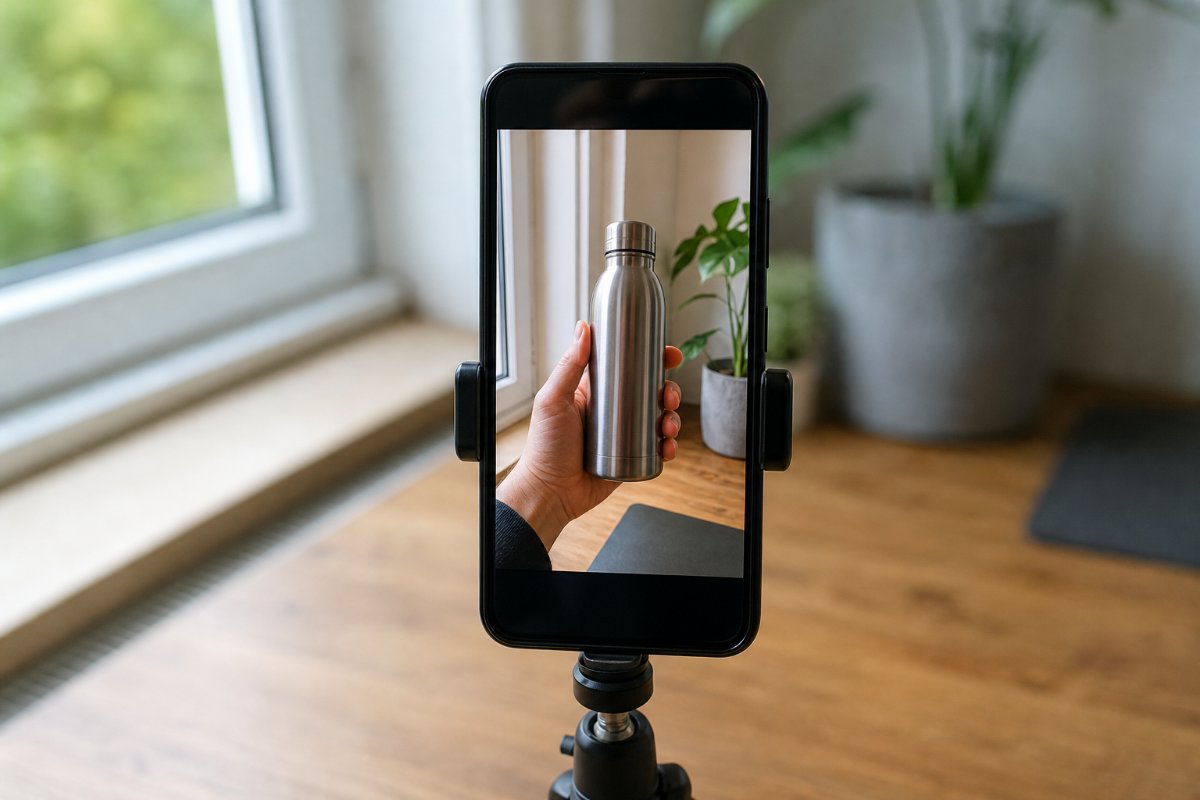
The whole session, once you've done it twice, takes less time than filming the full video three times. More to the point, the pieces fit.
Why the frozen second matters
That one second of stillness at the end of each hook and the start of the body is your edit handle. Without it, the cut lands mid-movement or mid-breath and looks like a glitch. With it, the editor can trim to the exact frame.
What has to stay identical between takes?
Everything the viewer could notice at the cut has to match. Run this before you press record on the hooks:
- Light. Window light changes fast near sunset. Film body and hooks within the same half hour. If a cloud moves in, wait.
- Clothes and hands. Same sleeves, same watch or bangles, same nail colour. Hair tied the same way if it's in frame.
- Product. Same hand, same angle, same fill level. If the body shows a full bottle, the hooks can't show it half empty. Film any shot that uses up the product last.
- Background. Nothing moved, no door opened behind you, the fan in the same state.
- Framing. Tripod untouched, same zoom, same focus lock.
- Voice. Same distance from the mic, same energy at the end of the hook as at the start of the body. A shouted hook into a calm body sounds like two different days.
The visual hook is the exception on framing. It can start on a close-up or a different angle, as long as it finishes on the handoff frame or cuts cleanly to it.
A worked example: one product, three hooks
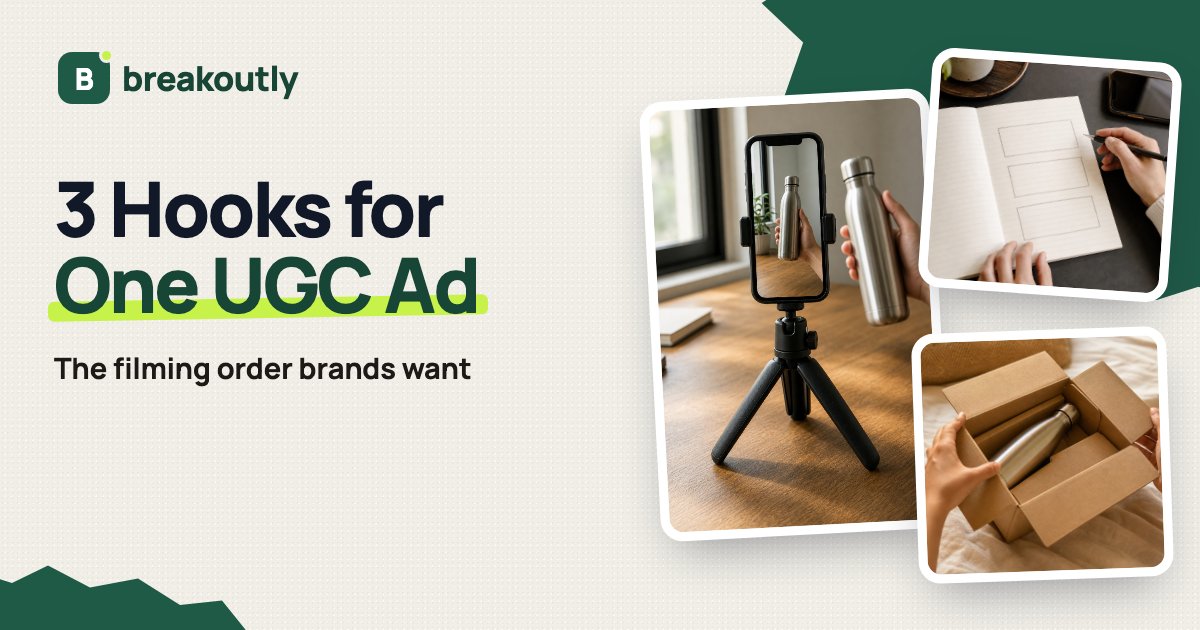
Take a plain insulated steel water bottle. No brand, the sort you'd find on any marketplace.
Body (same for all three, about 20 seconds): pour chai-hot water in at night, cap on, bottle on the desk; next morning, pour it out, steam visible; a line about fitting in a bag's side pocket; call to action as the brief words it.
Handoff frame: bottle held upright in the right hand at chest height, cap on, plain wall behind.
Hook A, problem. Picture: a regular plastic bottle on the desk, hand touches it and pulls back. Line: "Office pohanchte pohanchte paani garam ho jaata hai?" Text on screen: "Garmi mein thanda paani 2 ghante bhi nahi tikta". Then the hand swaps in the steel bottle and lands on the handoff frame.
Hook B, visual. Picture: steam rising as water pours out of the steel bottle in close-up, no words for the first second. Line: "Ye paani maine kal raat daala tha." Cut to handoff frame.
Hook C, question. Picture: you already in the handoff frame, bottle tilted toward the lens. Line: "Steel ki bottle lene se pehle ek cheez check ki hai aapne?" Text: "Lene se pehle ye dekh lein".
Three different doors. One room behind them.
A warning on Hook B. "Ye paani maine kal raat daala tha" is a factual statement. Only say it if it's true and you filmed it that way. Don't fake a result for a better hook; if the water wasn't hot in the morning, pick another opening and tell the brand what happened.
Roman Urdu hook lines you can adapt
These are skeletons. Swap in the product and the real detail.
| Type | Roman Urdu | English |
|---|---|---|
| Problem | "Har dafa yehi masla hota hai, na?" | "This happens every single time, right?" |
| Problem | "Main is cheez se tang aa gayi thi." | "I was fed up with this." |
| Visual | (silence, then) "Bas itna hi karna hai." | (silence, then) "That's all you do." |
| Visual | "Ye dekhein, phir baat karte hain." | "Watch this, then we'll talk." |
| Question | "Kya aap bhi ye ghalti karte hain?" | "Do you make this mistake too?" |
| Question | "Lene se pehle ye check kiya?" | "Did you check this before buying?" |
| Opinion | "Sach bataun? Mujhe laga tha ye bekaar hogi." | "Honestly? I thought this would be useless." |
| List | "Teen cheezein jo mujhe is mein pasand aayin." | "Three things I liked about this." |
Notice none of them promises a result. Hooks are where creators most often overclaim, because a big promise stops a scroll. A hook that says "ye aap ki zindagi badal dega" gives the brand a compliance headache, not a winner.
How do you deliver hook variations to a brand?
Deliver three finished videos (each hook already joined to the body) plus the separate clean files, unless the brief says otherwise. The finished videos let the brand upload straight away. The separate files let their editor build more.
A delivery folder that makes you look like you've done this before:
brand_product_hookA-problem_full.mp4brand_product_hookB-visual_full.mp4brand_product_hookC-question_full.mp4brand_product_body_clean.mp4brand_product_hookA_clean.mp4(and B, C)brand_product_broll.mp4hooks.txtwith each spoken line and on-screen text typed out
"Clean" means no music, no captions, no stickers, original audio. Export at the resolution you filmed in, 9:16.
The naming looks fussy. It isn't. When the media buyer reports that "hook B won", everyone knows which file that is, and you find out which of your openings worked. That feedback is worth asking for: "Could you tell me which hook you ran with?" Most beginners never ask, and so never learn.
What should you agree in writing first?
Agree what counts as a deliverable before you film, because "3 hooks" means different things to different brands. Ask:
- Is that one video with three openings, or three full videos? (Usually the first. Confirm.)
- Do they supply the hook lines, or do you write them for approval?
- Do they want finished cuts, raw files or both?
- Are extra hooks later a paid add-on?
- Will the hooks run as ads, and for how long?
That last one is a usage question, and usage is where money and rights hide. Our guide to UGC usage rights for beginners explains the terms, and questions to ask brands as a UGC creator has the full list with wording. If the brand wants to run the video from your own account, read up on the Spark Ads code too.
We're not giving a price for hook add-ons. Rates vary too much by market and brand to state one honestly. The point is that extra openings are extra work, and you set the terms before the shoot, not after.
What mistakes ruin hook variations?
- Three wordings, one idea. "You need this", "You have to try this", "You'll love this". That's one hook.
- Filming hooks on a different day. Different light, different nails, different energy. The cut screams.
- A hook that sets up a different video. If hook A is about leaking and the body never mentions leaking, viewers feel tricked and the brand's test tells them nothing.
- Hooks that run long. A 9-second "hook" is an intro. Keep the spoken part to one breath.
- Music baked in. The editor can't remove it. Always include clean files.
- A promise in the hook the product can't keep. Scroll-stopping and ad-approved are two different tests. Pass both.
How do you find hook ideas worth filming?
Look at openings that already beat a creator's normal numbers in your niche and language, then write your own in the same shape. Copying a line word for word is lazy and often doesn't fit your product anyway; the shape is what transfers.
In Breakoutly's Discover, search your product type and filter by language. Each video shows an outlier multiplier: its views divided by that creator's median, with the formula and freshness shown. Open "Why it worked" on a few high-multiplier videos and note what type of hook each used. You'll often see one type dominate a niche, which tells you which of your three to put the most care into. Keep the references in Saved.
Then in Studio, draft hook lines in Roman Urdu, Urdu, Hindi, Arabic, Bahasa or English and pick three of different types. If the same creators keep turning up with strong openings, follow them in Tracking.
Once you've filmed a set you like, put one body with its three hooks side by side in your portfolio. It shows a brand you understand testing, which most beginner portfolios don't. Building a UGC portfolio as a beginner covers how to lay it out.
FAQ
What are hook variations in UGC?
Hook variations are different openings for the same UGC ad. The first 2 to 4 seconds change (the picture, the spoken line or the on-screen text) while the body of the video stays identical. Brands use them to test which opening holds attention best without changing anything else in the ad.
How many hooks should a UGC creator deliver?
Deliver the number the brief asks for, which is most often three. TikTok's creative best practices suggest 3 to 5 different creatives per ad group, and one body with three openings gives a brand three ads from a single shoot. Confirm in writing whether extra hooks later are paid add-ons.
Do I film the whole video three times for three hooks?
No. Film the body once, then film each hook as a short separate clip that ends on the same frame the body starts from. Keep light, clothes, framing and product position identical so any hook can be cut onto the body. Then export three finished videos and the clean separate files.
How long should a UGC hook be?
Keep a UGC hook to about 2 to 4 seconds, or one short spoken sentence. TikTok's guidance says to introduce your main point in the first 3 seconds and prioritise the hook within the first 6. If your opening runs past that, it's an intro, and the product is arriving too late.
Why do brands test hooks instead of whole videos?
Brands test hooks because TikTok's ad testing guide recommends changing only one variable per test, so the result is readable. The opening is quick to swap and is the first thing viewers judge. Keeping the body the same means any difference in results comes from the hook alone.
Should the three hooks be the same type?
No. Make them clearly different: for example one problem hook, one visual hook and one question hook. TikTok's creative guidance says creatives with big differences are better for testing. Three near-identical lines give the brand one idea tested three times, which teaches them nothing.
By Breakoutly Research
Breakoutly researches short-form video for creators outside the US. Every article cites its sources and is checked by a person before it goes live.