On this page
- Why is jewellery good for faceless UGC?
- How do the shot lists below work?
- 10 jewellery UGC video ideas with shot lists
- How do you light jewellery so it shines without glare?
- What can't you say in a jewellery UGC video?
- What should you check before you film?
- How do you research before you shoot?
- How do you turn these samples into paid work?
- FAQ
Quick answer: The best jewellery UGC video ideas are short hands-only demos: a ring turning in window light, bangles stacked on a wrist with their sound, a jhumka swinging, a necklace clasped from behind, a set laid out on plain cloth. Film 15 to 30 seconds in 9:16 with soft, diffused light. Don't say "real gold", "anti tarnish" or "skin safe" unless the brand proves it in writing.
Jewellery is tiny, shiny and curved, which makes it about the worst thing you can point a phone at. You line up a pair of earrings on your dressing table, tap record, and get two white blobs of glare with your own phone reflected in the middle. Then the focus hunts back and forth and settles on the tablecloth.
We read the pages ranking for jewellery UGC video ideas on 23 November 2026 (and the US spelling, jewelry, which returns almost the same list). Every one of them is written for brands, not for the person holding the phone. The top result is a sales page. Lighting advice stops at "use natural light". None has a shot list. None mentions artificial jewellery, bangles or jhumkas, and none tells a creator what they shouldn't say about plating, tarnish or allergies.
This is the creator-side version: ten faceless ideas with timed shots and hooks, a lighting section that deals with glare, and a claims section with sources. Use whatever's in your own jewellery box. No brand names needed.
Why is jewellery good for faceless UGC?
Jewellery suits faceless UGC because the product is worn on the parts of you that aren't your face: fingers, wrists, ears, collarbone. A brand selling rings needs a hand, not a personality.
UGC means user generated content: short videos a creator films for a brand to use in its ads or on its page. For jewellery, brands mostly want three things from that footage. Scale (how big is it on a real person). Movement (does it catch light, does it swing). And finish (what does the surface look like up close). You can deliver all three from the wrist down.
There's a regional advantage too. Artificial jewellery, the plated and stone-set pieces sold for weddings, Eid and everyday wear, is something buyers in Pakistan and India shop for constantly, and almost nobody is filming it well for the small online sellers who stock it.
How do the shot lists below work?
Each idea follows the same rules so you can film several in one sitting.
- Length and format. 15 to 30 seconds, vertical 9:16, best quality your phone records. TikTok's creative best practices for performance ads (last updated June 2025) ask for 9:16 and at least 720p.
- Three hooks. Film the opening three ways. That same page says to prioritise your hook in the first 6 seconds and introduce your main point in the first 3. See how to film three hook variations for one UGC ad.
- Clean hands. Trim and clean your nails, moisturise ten minutes before, wipe off fingerprints from the piece with a soft cloth. In a macro shot, a dry cuticle is the size of the ring.
- A clean copy. Export one version with no music, captions or stickers for the brand's editor.
Timings are guides. Trim in the edit.
10 jewellery UGC video ideas with shot lists
1. The ring turn
One ring, one hand, one window. This is the shot every jewellery ad needs.
- 0 to 3s: hook. Your hand enters the frame from below, ring already on.
- 3 to 10s: rotate your wrist slowly, about a quarter turn each way, so light travels across the stone or surface.
- 10 to 16s: curl your fingers around a cup or the edge of a dupatta. A relaxed hand looks better than a posed one.
- 16 to 20s: bring the ring close to the lens, hold until focus locks.
Hooks: "Haath pe kaisi lagti hai? Yeh dekhein." / "Adjustable ring, on an actual hand." / "Watch what it does in window light."
2. The bangle stack (with sound)
Bangles are one of the few products that sell on sound. Record this one in a quiet room and keep the audio.
- 0 to 3s: hook. A bare wrist, a stack of bangles held in the other hand.
- 3 to 12s: slide them on two or three at a time.
- 12 to 18s: shake the wrist gently once. Let the chhan-chhan come through.
- 18 to 25s: turn the forearm so the camera sees the full stack from the side.
Hooks: "Awaaz sun lein pehle." / "Twelve bangles, one wrist." / "The sound is the whole point."
3. The jhumka swing
Earrings filmed flat look dead. They need to move.
- 0 to 3s: hook. One jhumka held by its hook between two fingers, against a plain wall.
- 3 to 9s: flick it lightly so it swings. Film at normal speed and once in slow motion.
- 9 to 16s: place it in your open palm to show size.
- 16 to 24s: worn, filmed from behind your shoulder so only the ear, earring and hair show. Turn your head a little so it swings again.
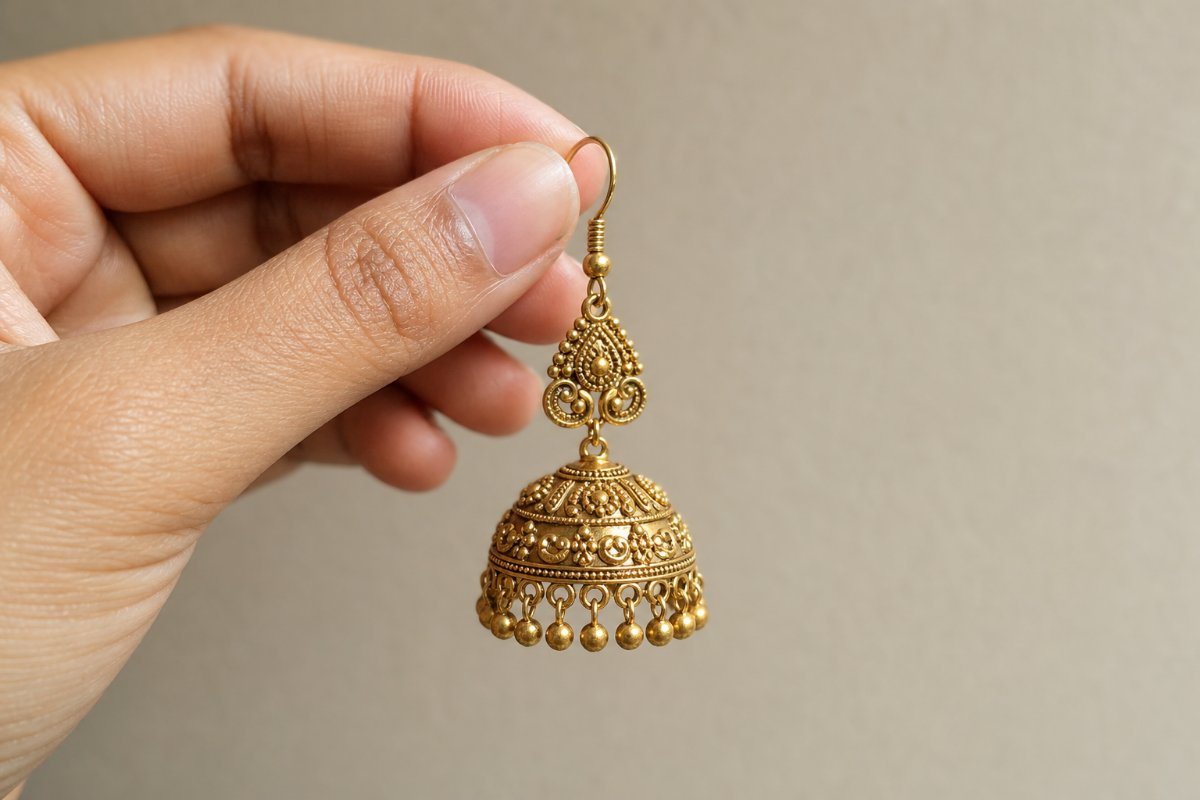
Hooks: "Jhumka ka size haath pe dekh lein." / "Swing test." / "Heavy or light? Watch how it moves."
4. The clasp from behind
Necklaces are awkward to film from the front without a face. From behind, the clasp shot is clean and oddly satisfying.
- 0 to 3s: hook. Hair swept to one side, both hands bring the chain around the neck.
- 3 to 10s: close the clasp. If you fumble, keep it, then cut to the take where you don't.
- 10 to 18s: cut to the front, framed from chin down to collarbone. The pendant settles.
- 18 to 24s: one finger straightens the pendant.
Hooks: "Clasp akele band ho jaata hai ya nahi?" / "Where it sits on the neckline." / "Chain length, on me."
Saying where the chain falls on you is a fact a buyer can use. So is the neckline you're wearing.
5. The full set on plain cloth
For bridal and party sets: necklace, earrings, tikka, bangles. Overhead, on a plain dark or cream cloth. Not on a printed bedsheet.
- 0 to 3s: hook. Empty cloth, your hand places the necklace in the centre.
- 3 to 12s: add earrings either side, then the tikka above.
- 12 to 20s: slow overhead move from top to bottom of the set.
- 20 to 28s: lift one earring to show its back and the post or hook.
Hooks: "Poora set, aik frame mein." / "Everything in the box, laid out." / "Front, then the back nobody shows you."
6. The size check
A product photo on a white background gives no sense of size, so buyers guess. Remove the guess in ten seconds.
- 0 to 3s: hook. The piece on your open palm.
- 3 to 8s: next to a common object: a coin, a key, a lipstick.
- 8 to 15s: worn.
Hooks: "Size ka andaza aise lagayein." / "Next to a 5 rupee coin." / "Smaller than you think? Here's scale."
7. Parcel to wrist
An unboxing that ends with the piece on, not on the table. Our faceless unboxing UGC shot lists cover packaging shots in more depth.
- 0 to 3s: hook. The sealed pouch or box in both hands.
- 3 to 10s: open it. Show how the piece is packed: bubble wrap, pouch, card.
- 10 to 18s: lift it out and hold it to the light.
- 18 to 26s: put it on.
Hooks: "Packing kaisi aayi, dekhte hain." / "From courier bag to wrist." / "Opened on camera, worn on camera."
8. One piece, three necklines
Styling content gets saved. This one needs three tops and one necklace.
- 0 to 3s: hook. The necklace on a hanger hook or draped over your fingers.
- 3 to 10s: with a round neck kameez, chin-down framing.
- 10 to 17s: with a V neck.
- 17 to 24s: with a collared shirt.
Hooks: "Aik necklace, teen necklines." / "Which neckline does it suit?" / "Same chain, three outfits."
If you're filming for clothing brands as well, the two pair naturally. Our clothing UGC video ideas use the same chin-down framing.
9. Mehndi and bangles (Eid and wedding season)
Hands with mehndi are the best jewellery display there is, and a format buyers here already associate with celebration.
- 0 to 3s: hook. Both hands with dry mehndi, palms down, on a plain cloth.
- 3 to 12s: slide bangles on one wrist.
- 12 to 20s: add a ring.
- 20 to 28s: both hands together, slow turn to show palms and backs.
Hooks: "Chaand raat ready." / "Mehndi, choorian, bas." / "Eid hands."
10. The getting ready tray
No body in frame. A tray, a plain surface, the pieces you'd wear to a dawat.
- 0 to 3s: hook. Empty tray.
- 3 to 14s: hands add earrings, ring, bangles and a watch, one at a time.
- 14 to 22s: slow pan across.
- 22 to 28s: one hand lifts the earrings out, as if leaving.
Hooks: "Aaj ki dawat ke liye yeh." / "Tonight's picks." / "What I'm wearing, before I wear it."
How do you light jewellery so it shines without glare?
Use one soft light source from the side, usually a window covered with a thin white curtain, and bounce light back with a sheet of white paper on the other side. Hard, direct light (bare sun, a phone torch, a ring light pointed straight at metal) is what creates the white blobs.
Shopify's product photography guide explains the problem: reflective products are harder to shoot because of light spots and distracting reflections, and its fix is to place a diffuser between your light source and your product. It lists white foam board, black foam board and white paper as budget reflectors. Nikon's jewellery photography guide goes a step further and recommends a light tent, saying it will "soften and diffuse the light and provide consistent results".
Both guides are about still photos on proper cameras. The same principle carries over to phone video, and here's the home version:
- Diffuser: a white dupatta or thin curtain over the window.
- Reflector: white chart paper propped against a book, opposite the window.
- Light tent: a white plastic storage box on its side, or a cardboard box with the sides cut out and covered in butter paper.
- Background: plain. Matte cloth, not glossy tile.
Now the catch. Perfectly diffused light makes metal look smooth, but it can make stones look flat, because sparkle is just small hard reflections moving. So move the piece, not the light. That's why almost every shot above includes a slow turn. This is our own practice, not something those guides state.
Check what's reflected, too. Polished metal is a mirror. If you can see your phone, your hand or the ceiling fan in it, shift your angle a few degrees until it shows the white paper instead.
How close can a phone get?
Closer than you'd think on newer phones, not close enough on older ones. Apple's iPhone guide says supported models can focus "as close as 2 centimeters" in macro mode, and that if the image goes blurry you should back up or switch to the 0.5x camera. We didn't find an equivalent official page for Android phones, so use the same rule: move back until focus locks, then crop in the edit. A sharp shot from 10 centimetres beats a blurry one from 3.
Nikon's guide suggests manual focus for the smallest pieces like earrings. On a phone, press and hold on the piece to lock focus before you move.
What can't you say in a jewellery UGC video?
Don't state what a piece is made of, how long its finish lasts or how skin reacts to it unless the brand gives you that claim in writing. You can't test any of it at home, and those are exactly the claims rules are written about.
TikTok's Branded Content Policy (effective 30 October 2026) says: "You must not make false, deceptive or misleading claims about any products or services." Its ad policy on misleading and false content (last updated November 2026) says ads "must not promise or exaggerate results concerning a product's effect", disallows absolute terms, and flags prices or discounts in an ad that don't match the landing page. We found no TikTok ad policy page that names jewellery specifically. The general rules are the ones that apply.
| Instead of | Say |
|---|---|
| "Real gold" or "pure silver" | "Gold toned" or "silver toned", or the brand's exact written description |
| "Gold plated" (your guess) | Only if the brand states it. Otherwise "gold colour finish" |
| "Anti tarnish, guaranteed" | "This is how it looks on day one" |
| "Never turns black" | Nothing about lifespan |
| "Hypoallergenic, skin safe" | Nothing about skin, unless the brand supplies proof |
| "Looks exactly like the designer one" | Don't film it. See below |
| "Only Rs. 499, cheapest anywhere" | No price, unless the brand gives you the line |
Why "gold plated" isn't a casual phrase
Because regulators define it. In the United States, the FTC's Jewelry Guides say it's unfair or deceptive to misrepresent a product's metallic content (16 CFR 23.1), and they allow "gold plated" only where the plating is thick enough that "reasonable durability is assured" (16 CFR 23.3). UK guidance from the British Hallmarking Council says items sold as gold above a set weight "must have a legally recognised hallmark", in a shop or online. TikTok Shop's US prohibited products policy (updated 19 November 2026) bars jewellery listings that misrepresent "metal type, purity, fineness, weight, plating, coating, or material composition".
Those are US and UK rules, not Pakistani law, and we didn't find a Pakistani standard for describing plated jewellery. But they show how seriously the words are taken wherever a brand might run your video. Describe what you see: colour, finish, style. Leave composition to the brand.
Why not "skin safe"?
Because nickel allergy is common and you can't see nickel. The NHS lists nickel or cobalt in jewellery among the allergens that commonly cause allergic contact dermatitis. The American Academy of Dermatology calls nickel "one of the most common causes of allergic contact dermatitis" and names earrings and earring backs among the biggest culprits.
"Hypoallergenic" isn't a banned word; the AAD itself tells people with the allergy to look for nickel-free, hypoallergenic jewellery. The issue is that a viewer may rely on it. If the brand has a test report, they can make the claim in their caption. You don't have to voice it.
Copies of famous designs
If a seller describes a piece as a copy of a named luxury brand's design, don't film it. TikTok's intellectual property ad policy (last updated April 2026) doesn't allow ads that display or promote counterfeit products and covers unauthorised replicas and imitations of a brand. To be clear, that's about copying a brand. Artificial jewellery as a category is fine. Naming a luxury house or saying "dupe of" is where the trouble starts.
What should you check before you film?
Four things, two minutes:
- Wipe every piece. Fingerprints show in macro.
- Check the reflection in the metal from your camera angle.
- Turn off the ceiling fan if earrings or chains are hanging; turn it back on only for the swing shot.
- Ask the brand what you may say about material. If they answer "just say gold plated", ask them to send that in writing. Our list of questions to ask brands as a UGC creator has the rest.
How do you research before you shoot?
Look at what's already working for jewellery in your language before choosing which ideas to film. In Breakoutly's Discover, search a term like "jhumka", "bangles" or "artificial jewellery" and filter by language. Each result shows an outlier multiplier, the video's views divided by that creator's median, with the formula and how fresh the number is. A 5x video from a small seller's account is a better template than a famous creator's average post.
Open "Why it worked" on a few to see the hook and the format. Keep the strongest in Saved. When you need hook lines, Studio drafts them in Urdu, Roman Urdu, Hindi, Arabic, Bahasa or English. And if two or three jewellery sellers keep turning up, add them in Tracking to watch what they post before wedding season and Eid.
Check every generated line against the table above. A script tool will write "real gold plated" without blinking.
How do you turn these samples into paid work?
Film three: one ring or bangle shot, one earring shot, one set or styling shot. That's enough to show a jewellery seller you can handle small shiny things, which most creators can't.
Put them in a simple portfolio (UGC portfolio for beginners shows the layout) and pitch small online sellers first, using the templates in how to pitch brands for UGC in Pakistan.
If a brand sends you a piece for free and you post about it on your own account, that counts as branded content. TikTok's policy lists a gifted product as an incentive, and its help page says creators must turn on the commercial content disclosure setting (last updated April 2026). TikTok says doing so won't affect how the video is recommended.
FAQ
What are good jewellery UGC video ideas for beginners?
Good jewellery UGC video ideas for beginners are hands-only demos that show scale, movement and finish: a ring turning in window light, bangles sliding onto a wrist with sound, an earring swinging, a necklace clasped from behind and a full set laid on plain cloth. Keep each to 15 to 30 seconds in vertical 9:16.
How do I film jewellery on a phone without glare?
Use one soft light from the side, such as a window covered with a thin white curtain, and prop white paper on the opposite side to fill shadows. Avoid direct sun, flash and a ring light aimed straight at metal. Then tilt the piece a few degrees until it reflects the white paper, not your phone.
Can I make jewellery UGC without showing my face?
Yes. Jewellery is worn on hands, wrists, ears and the collarbone, so every shot can be framed without a face. Film rings and bangles from the wrist down, earrings from behind your shoulder, and necklaces from the chin down or from behind while you close the clasp.
Can I say artificial jewellery is gold plated or anti tarnish?
Only if the brand states it in writing, and even then it's safer to let the brand make the claim. TikTok's Branded Content Policy, effective 30 October 2026, bars false or misleading product claims, and US FTC guides define when "gold plated" may be used. Describe the colour and finish you can see.
How close should I hold the phone to film a ring?
Hold it as close as your phone will focus and no closer. Apple says supported iPhones can focus as close as 2 centimetres in macro mode; many other phones need more distance. If the picture goes soft, move back until focus locks and crop later. Press and hold on the ring to lock focus.
Do I need to disclose a gifted jewellery piece on TikTok?
Yes, if you post about it on your own account. TikTok's Branded Content Policy counts a product gifted by a brand as an incentive, and creators must turn on the commercial content disclosure setting for such posts. TikTok says the setting does not affect how the video is recommended.
By Breakoutly Research
Breakoutly researches short-form video for creators outside the US. Every article cites its sources and is checked by a person before it goes live.